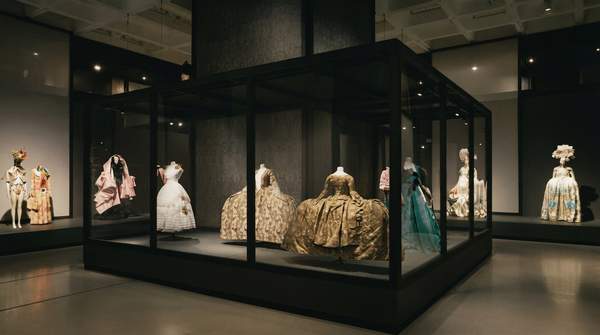
Fashion's place in the art museum was not granted; it was argued for, show by show. Three American exhibitions mark the turning points: MoMA's Are Clothes Modern? in 1944, the Metropolitan Museum of Art's Yves Saint Laurent retrospective in 1983, and the Museum at FIT's Art X Fashion in 2026. Each took a different curatorial route to the same question—whether dress belongs among the serious arts—and each left the institution changed.
Fashion's Ascent: From Utility to Art in Museum Exhibitions
For most of their history, public museums kept textiles at arm's length. As the publication 1 Granary recounts, textile departments were long treated as secondary, staffed largely by women curators whose work was "often dismissed as frivolous." Fashion itself internalized this hierarchy: New York Times fashion journalist Vanessa Friedman observed in 2016 that fashion "has long been seen, and often sees itself, as the stepchild of the art world; the less worthy creative form."
The shift came slowly and unevenly. Phaidon's editorial team notes that although fashion exhibitions now seem a staple of major museums' programming, "it was not until the 1980s that fashion took a stand as a legitimized fine art form." The three exhibitions examined here each attacked the old hierarchy from a different angle—one polemical, one theatrical, one explicitly symbiotic.
MoMA's 'Are Clothes Modern?' (1944): A Critical Examination of Dress
The Museum of Modern Art's 1944 exhibition Are Clothes Modern?, curated by the architect Bernard Rudofsky, was the only time the museum dedicated an entire program to the subject until 2017, according to MoMA curators Paola Antonelli and Michelle Millar Fisher. That isolation is itself telling: even a museum devoted to modern design hesitated for seven decades before returning to fashion at full scale.
Rudofsky's approach was polemical rather than celebratory. As Antonelli and Millar Fisher describe it, he pioneered an object-centered, design-led investigation that traced designs rather than designers, and social concerns rather than individual biographies. His aim was in great part to relocate fashion within wider discourses of design, art, society, and culture. The show's significance lies less in legitimizing fashion as art than in proving that a major art institution could subject clothing to serious intellectual scrutiny at all.
The Met's Yves Saint Laurent Retrospective (1983): Elevating the Couturier as Artist
The decisive institutional breakthrough came four decades later. The Metropolitan Museum of Art's 1983–84 Yves Saint Laurent retrospective, curated by former Vogue editor Diana Vreeland, was, in Phaidon's account, "the exhibition that kick-started it all"—a groundbreaking endeavor presenting current fashion rather than historic costume.
Vreeland's achievement was twofold. Her theatrical exhibitions during her tenure at the Costume Institute abolished the aura of antiquarianism previously associated with costume display, and they became the most influential examples of an emergent genre. By mounting a retrospective for a living designer, the Met treated a single couturier's body of work with the reverence previously reserved for painters, elevating the designer to the status of artist and establishing a template for the commercially successful fashion blockbuster that museums have followed since.
FIT's 'Art X Fashion' (2026): Exploring Symbiotic Artistic Expression
The Museum at FIT's Art X Fashion, on view from February 18 to April 19, 2026, represents the current stage of the argument. Curated by Dr. Elizabeth Way, the museum's curator of costume and accessories, the exhibition featured more than 140 objects—garments, accessories, textiles, photographs, and original artworks drawn from MFIT's permanent collection.
Its curatorial move was to reframe the relationship entirely. According to the museum, the exhibition explored "the ways that fashion has always been a partner, not a follower, of fine art," tracing collaborations from Rococo and Neoclassicism through Surrealism, Pop Art, and postmodernism. The examples are concrete: Yves Saint Laurent recreated Piet Mondrian's color blocks on the three-dimensional body; Eric Gaskins' beadwork paid homage to Franz Kline's brushwork; Christian Francis Roth invoked Matisse's fauvist palette. The show's core, the museum states, was its engagement with the eternal question: "Is fashion art?"
Comparative Milestones in Fashion Exhibition History
Placing the three shows side by side reveals how the curatorial argument evolved: from questioning dress itself, to canonizing a single designer, to declaring fashion an equal partner of fine art. Each row below reflects the specific contribution its exhibition made to fashion's institutional standing.
| Exhibition & Date | Institution | Key Curatorial Innovation | Impact on Fashion's Status |
|---|---|---|---|
| Are Clothes Modern? (1944) | Museum of Modern Art | Object-centered, design-led investigation tracing designs rather than designers, per curators Paola Antonelli and Michelle Millar Fisher | Initiated serious intellectual engagement with fashion at a major art institution; MoMA's only full-scale fashion exhibition until 2017 |
| Yves Saint Laurent retrospective (1983–84) | Metropolitan Museum of Art | First retrospective of a living fashion designer, presented theatrically by curator Diana Vreeland with current fashion rather than historic costume | Kick-started the legitimization of fashion as a fine art form in major museums and established the blockbuster model |
| Art X Fashion (2026) | The Museum at FIT | Curated by Dr. Elizabeth Way; explored fashion as a partner, not a follower, of fine art through more than 140 objects from MFIT's collection | Challenged traditional hierarchies of visual culture, presenting fashion and art as parallel expressions of creative force |
The progression is visible in the table's third column: the question moved from whether clothes are modern, to whether a designer is an artist, to whether fashion and art were ever truly separate. Each show built on the last, and none could have made its argument without the ground the previous one had cleared.
The Evolving Debate: Fashion's Place in the Art World
What unites these exhibitions is that each confronted fashion's "low status" directly. Rudofsky did so by treating clothing as a design problem worthy of MoMA's attention. Vreeland did so by abolishing the antiquarian aura around costume display. Way did so by arguing, through objects, that fashion has always collaborated with fine art rather than imitated it.
The debate is not settled. Fashion historian Valerie Steele, director of the Museum at FIT, has argued that fashion's place within the museum "replicates the traditionally low status of fashion within academia"—a resistance that, as Phaidon notes, continues today. Yet since the 1990s, renowned museums have become advocates of a natural overlap between art and fashion, an existence that has become an unavoidable part of contemporary visual culture. Within Art X Fashion itself, art and fashion historian Dr. Christopher Richards of Brooklyn College offered one working answer: if fashion has innovative forms, exquisite craftsmanship, and cultural impact, then it is art.
Future Curatorial Directions: Integrating Fashion and Art
The trajectory from 1944 to 2026 suggests a clear direction for museums and cultural institutions: continue presenting fashion as a legitimate and complex art form, moving beyond mere historical costume or commercial display. The evidence favors this course—each escalation of curatorial ambition, from Rudofsky's polemic to Vreeland's blockbuster to Way's symbiotic framing, has been met with institutional acceptance rather than retreat.
The measurable indicator of success is concrete: an increase in interdisciplinary exhibitions that explicitly link fashion with fine art, and a greater representation of contemporary fashion designers within art museum collections and programming. Readers can watch for exactly that—whether museums follow Art X Fashion's lead in acquiring contemporary designers' work and staging shows that treat fashion and art as partners, or whether the old hierarchy reasserts itself in the next decade's programming.
Sources
- The rise and rise of the fashion exhibition — 1granary
- The Evolution of the Fashion Exhibition — Phaidon
- The Museum of Modern Art’s Items: Is Fashion Modern? — Brooklynrail
- Art X Fashion — FITNYC