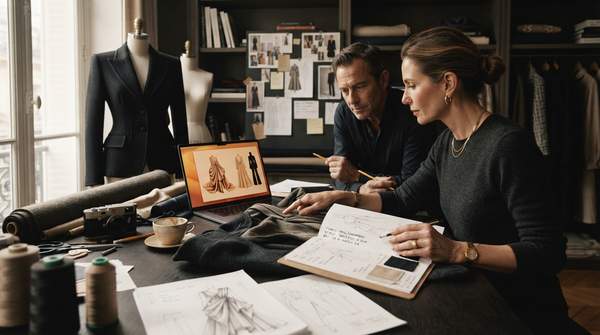
Luxury fashion houses are using artificial intelligence to compress design iteration cycles from weeks to days, but the technology's real value depends on where it sits in the workflow. At LVMH, designers at Louis Vuitton, Dior and Fendi use internal AI platforms for material exploration, color testing, mood boards and fabric simulation, according to reporting from Florida International University's Pino Global Leadership Forum. Yet the same reporting landscape makes a sharper point: every brand surveyed still has a human review the final flats, tech packs and imagery. AI accelerates the front of the creative process; it has not yet replaced the judgment at the end of it.
Concept & Ideation: AI as a Creative Co-Pilot
The earliest stage of luxury design—mood boards, pattern variations, colorways—is where AI has gained the firmest foothold. LVMH's internal platforms focus on exactly these tasks: material exploration, color testing and rapid product visualization, work that historically consumed significant time during the creative process. Designers across the conglomerate's 75 maisons use these tools to generate mood boards and explore pattern variations before committing to a direction.
Publicly available platforms extend the same capability beyond the conglomerates. LOOK AI, a fashion-specific generative design platform, positions itself as a creative co-pilot that handles complex design prompts—one designer's testimonial on the platform's site describes it as a co-pilot that "never runs out of fresh ideas." Such testimonials are user reporting rather than independent testing, but they illustrate how the category is framed: AI as an inexhaustible idea generator, not a decision-maker. The designer's role shifts from producing every variation to curating them.
Prototyping & Visualization: Bringing Designs to Life
The second stage is where AI moves from inspiration to simulation. LVMH designers use AI to simulate how different fabrics will drape or reflect light—replacing some physical sampling with digital iteration. This is the practical meaning of "rapid visualization": a designer can test a silk versus a twill, a matte versus a luster finish, without cutting a single meter of cloth.
Independent tools offer parallel capabilities. A 2026 guide from StyTrix describes platforms combining fashion-specific generative AI with virtual try-on on customizable models offering more than 15 attributes, including body type, ethnicity and age, alongside an AI fabric generator that visualizes more than 12 materials and 10 patterns in six presentation styles. WearView's 2026 survey of pattern-making software highlights Style3D, which runs AI-driven 3D garment simulation on an in-house physics engine and covers, in WearView's assessment, the chain from design idea to production file to marketing render. The common thread: designers can see a garment behave before it exists.
AI Applications Across the Luxury Fashion Design Workflow
The framework below categorizes specific AI applications by workflow stage, drawing on the LVMH reporting and the 2026 tool surveys. The key limitation column is the critical one: it marks where each application stops short of manufacturing.
| Design Stage | AI Application | Key Benefit | Practical Limitation / Key Consideration |
|---|---|---|---|
| Concept & Ideation | Text-to-fashion generation, mood boards, material and color exploration, pattern variations (LVMH internal platforms; LOOK AI) | Accelerates early-stage design; rapid visualization; a continuous supply of fresh ideas acting as a creative co-pilot | Outputs are inspirational; generic image tools were not trained on garment construction and cannot inform manufacturing decisions |
| Prototyping & Visualization | 3D garment simulation on physics engines, fabric draping and light-reflection simulation, virtual try-on (Style3D; StyTrix-surveyed platforms) | Designs can be seen on customizable models—15+ attributes—and materials visualized—12+ fabrics—before physical production | Simulation approximates behavior; it does not itself produce a factory-usable pattern or specification |
| Production Readiness | Automated pattern and trim generation from design inputs; tech pack creation (Style3D; The New Black AI) | Streamlines technical documentation and production files, connecting designs to manufacturing | Only a few tools genuinely connect to real garment production; human review of final flats, tech packs and imagery remains universal in 2026 |
Read vertically, the table shows a progression of increasing stakes and decreasing automation. Read horizontally, it shows that each stage's benefit comes paired with a boundary the technology has not yet crossed.
The 'Inspiration vs. Production' Gap: A Critical Distinction
The central problem in AI fashion design is that visual impressiveness and manufacturability are different qualities. A 2026 guide from AI Fashion Vault states the divide bluntly: "A pretty render is not a tech pack. A polished concept image is not a flat." Generic image generators like Midjourney are, in that guide's assessment, excellent for inspiration but not trained on garment construction—they produce pictures of clothes, not instructions for making them.
This is the gap that catches out both designers and observers. A garment that looks flawless in a generated image may be physically impossible: seams that don't align, drapes no real fabric would produce, construction no pattern could yield. The image is a rendering of an idea of a garment, not a specification of one. Luxury manufacturing, with its tolerance standards and atelier craft, exposes this gap more ruthlessly than mass production.
Bridging the Gap: AI for Production Readiness
A small set of tools does cross the divide. Style3D offers automated pattern and trim generation from design inputs, moving from design idea toward production file. The New Black AI advertises tech pack creation alongside its design generation, aiming to carry a garment from first design to product page. These are the applications that matter for a designer evaluating tools: not what the output looks like, but whether a factory can use it.
Even here, the bridge is partial. The AI Fashion Vault guide reports that every brand it spoke with uses AI to accelerate early stages "and still has a human review the final flats, the final tech pack, and the final imagery." Automation generates the draft; a human owns the specification. That division of labor is the honest current state of the technology in 2026.
Evaluating AI Tools for Your Workflow
The AI Fashion Vault guide proposes three filters that separate a useful tool from a demo. First: does it produce an output a factory or a customer can use? Second: does it understand fashion-specific structure, or is it a generic image model repurposed? A designer should ask these questions against their immediate task—mood board, prototype, or production file—rather than against a tool's marketing.
Practical considerations compound the evaluation. WearView notes that Style3D's pricing is quoted only through sales, making comparison shopping impossible, and that its multi-product family takes time to map onto an existing workflow. StyTrix documents a range from free tiers to enterprise plans across the category. A tool that cannot be priced or fitted into a team's process carries a cost beyond its subscription.
Making AI Work for Production: A Designer's Decision
Designers should prioritize AI tools that demonstrate a clear pathway from visual output to manufacturable designs, rather than solely focusing on aesthetic generation. The measurable indicator is the one the evidence itself supplies: the presence of human review in the final stages of flats, tech packs and imagery indicates that AI outputs are not yet fully production-ready without intervention. A designer adopting any tool should test it against that standard—ask whether its output reaches a factory, and budget the human review time that, as of 2026, no brand surveyed has eliminated.
Sources
- Artificial Intelligence’s Transformative Impact on Luxury Goods Manufacturers — Business
- LOOK AI | AI Fashion Design Platform for Designers & Brands | Virtual Try-On
- 10 Best AI Tools for Fashion Designers in 2026 — Stytrix
- 8 best AI pattern making software for fashion brands (2026) — WearView
- AI Fashion Design Tools: Complete Guide for Designers 2026 — Aifashionvault
- The New Black AI — Thenewblack