Three-dimensional weaving replaces fashion's longest production chain with a single machine cycle. Instead of weaving flat cloth, cutting it into pieces, and sewing those pieces back together, a 3D loom interlocks yarns in three directions to form a near-net-shape garment directly on the machine. The approach, described in recent textile engineering research, eliminates spreading, cutting, and stitching, and it is drawing attention in luxury fashion for two reasons: it collapses waste, and it makes structures that flat fabric cannot hold.
What is 3D Weaving?
Conventional weaving produces a two-dimensional sheet. Everything three-dimensional about a garment is created afterward, through cutting and assembly. Three-dimensional weaving inverts that sequence. The loom itself shapes the fabric, interlocking yarns through the thickness of the structure as well as across its surface, so the woven article emerges already close to its final geometry.
A review of 3D woven fabric structures published in Fashion and Textiles traces the principle from early hand processes and the "tablet loom" to modern industrial machines, and credits the technique's growth to exactly the properties fashion now wants: "the ability to produce very complex parts without the requirement of assembling." The technology matured in demanding fields—concrete reinforcement, vehicle components—where eliminating joining and bonding steps justified the engineering investment.
Apparel is the newer application. The garment-tech company unspun, whose founders came from a custom-jeans venture using 3D body scanning, describes its process as weaving yarns into three-dimensional circular shapes whose diameter can be manipulated in real time by control software. In effect, the cut of the garment is designed into the fabric itself.
3D Weaving vs. Traditional Cut-and-Sew: A Paradigm Shift
The standard route to a garment is long. A fabric mill weaves a roll of cloth; that roll is spread and plied; pieces are cut from patterns; those pieces are sewn, trimmed, and finished. A 2024 open-access study on re-engineering apparel manufacturing calls the cut-and-sewn process labor-intensive across both pre- and post-production, and notes that even streamlined conventional weaving still requires sewing or joining after the cloth comes off the loom.
Three-dimensional weaving removes the middle of that chain. The study's authors conclude that the technology "can create 3D forms with complex near-net-shape geometries in a single weaving cycle, utilizing an independent weaving machine." Where cut-and-sew treats the garment as an assembly problem, 3D weaving treats it as a weaving problem—one solved before the yarn ever leaves the machine.
3D Weaving vs. Traditional Cut-and-Sew: A Comparative Overview
The table below contrasts the two methods across the factors that matter most to a luxury house deciding where the technology fits. Each finding draws on the technical literature and on manufacturers' own descriptions of the process; the trade-offs are structural, not promotional.
| Factor | 3D Weaving | Traditional Cut-and-Sew |
|---|---|---|
| Process | Yarns are woven directly into three-dimensional, near-net-shape garments on specialized looms with complex weft insertion. | Flat 2D fabric is woven, then spread, cut, and sewn—a multi-step process of manipulation and assembly. |
| Design complexity | Intricate textures, sculptural forms, and seamless garments difficult or impossible with flat fabric; self-supporting, multi-layered structures with built-in strength. | Complex forms typically require multiple seams and darts, with added components for volume or support. |
| Material waste | Far less waste: the garment is constructed as a single seamless piece, with the "cut" designed into the fabric itself. | Cutting pieces from rolls routinely leaves off-cut waste, compounding fashion's disposal problem. |
| Production steps | Eliminates spreading, cutting, and stitching; garments can be produced in minutes rather than months, according to unspun's description of its machines. | Each garment passes through separate weaving, cutting, and sewing stages, often across different factories. |
| Customization | Fit accuracy and size variation woven into the garment, with body-scan data feeding directly into the woven geometry. | Custom fit demands new patterns and re-cutting; scaling sizes multiplies pattern work. |
The comparison reads in one direction: every dimension where the methods diverge—seams eliminated, off-cuts avoided, steps collapsed—favors the 3D route, provided a house can access suitable machinery and design within its constraints.
Advantages for Luxury Fashion: Design Complexity
For designers, the appeal is expressive rather than merely logistical. Industry reporting on the technology describes garments with intricate patterns, textures, and forms that flat fabrics could not previously achieve. Because 3D textiles can be engineered self-supporting, lightweight, and adaptable—interconnected multi-layered fabrics with strength built in—a silhouette can hold its own architecture without internal scaffolding.
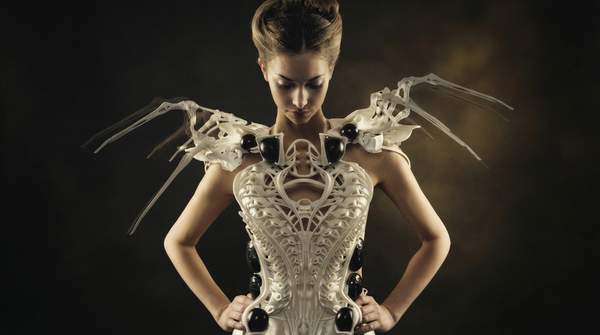
That sculptural register is already visible at couture's avant-garde edge. Reporting in the trade press notes that Balenciaga has experimented with 3D-printed couture and that Iris van Herpen is recognized for combining 3D printing with intricate handcraft. These are additive, not woven, processes—related in intent rather than mechanism—but they mark the same turn toward garments whose forms are built, not sewn. Three-dimensional weaving extends that logic to cloth itself.
Advantages for Luxury Fashion: Material Waste Reduction
Cut-and-sew waste is not incidental; it is built into the geometry. Laying flat pattern pieces inside curved seams guarantees leftover off-cuts, and the problem compounds at the industry level. Business Insider's reporting on fashion's waste crisis describes overproduction, inventory destruction, and returned garments ending in landfills as systemic features.
Three-dimensional weaving attacks the geometry rather than managing its consequences. Because the garment's shape is woven in, there is no cutting stage to produce scrap. The manufacturing claim, from unspun, is direct: its machines "waste far less material and use far less energy than cut and sew manufacturing methods." The more radical prospect is on-demand production. As co-founder Beth Esponnette's colleague put it, if a machine could make a garment straight from yarn, overproduction could be eliminated rather than managed.
Advantages for Luxury Fashion: Streamlined Production and Customization
Efficiency and personalization converge here. A single loom cycle removes spreading, cutting, and stitching; unspun states that one of its machines can produce an article of clothing in minutes rather than months. That compression matters less for mass volume than for made-to-measure luxury, where per-garment labor dominates cost.
Custom fit is the sharper advantage. The company's earlier denim line used 3D body scanning to make jeans to individual measurements, and Business Insider reports customers can be scanned with an iPhone's FaceID. Weaving the geometry directly from that data means a bespoke silhouette with no pattern-making iteration—garments that are ergonomic and seamless by construction. Its reported return rate of about 10 percent, against an industry plagued by returns, suggests fit accuracy carries commercial weight, though at roughly $200 per jean, the pricing reflects early-stage machinery costs rather than mature economics.
Embracing 3D Weaving for Sustainable Luxury Fashion
Luxury fashion designers and brands should explore integrating 3D weaving technology to achieve innovative designs, reduce environmental impact, and enhance production efficiency. The evidence supports that decision narrowly: the method demonstrably eliminates assembly steps, minimizes off-cut waste, and opens self-supporting structures flat fabric cannot match. Watch for the measurable signals of adoption—increased uptake of 3D weaving machinery by luxury manufacturers, and new collections built on seamless, complex, body-scan-customized garments—as the technology moves from principle to atelier practice.
Sources
- Evolution of 3D weaving and 3D woven fabric structures - Fashion and Textiles — SpringerLink
- What is 3D weaving and why is it important? — UNSPUN
- Re-engineer apparel manufacturing processes with 3D weaving technology for efficient single-step garment… — PMC
- Fibre2fashion
- Nothing left over: 3D weaving is the future of fashion — Thehustle
- 3D-weaving tech that uses body-scan data from shoppers could mean a better… — Business Insider