Creating a high-end Swiss watch movement is a two-worlds exercise: industrial machines cut components to tolerances of around 0.005 millimetres, and then artisans spend far longer decorating those parts by hand than it took to make them. The clearest window into this process comes from the Swiss manufacture Armin Strom, which produces 97 percent of its movement components in-house and documents each stage of the work. Its account shows why a bespoke movement is defined less by the machines that shape it than by the hands that finish and assemble it.
Introduction: The Essence of a Bespoke Swiss Movement
A mechanical watch's internal mechanism, excluding the face and hands, is the movement, and since the quartz era Swiss-made mechanical watches have been marketed primarily as luxury goods, purchased for their craftsmanship and aesthetic value rather than pure utility. That market position explains the peculiar economics of a bespoke movement: the functional parts could be produced faster and more cheaply, yet the manufacture deliberately adds hours of hand work that most owners will never see. Armin Strom's own description of its process — design, component production, decoration, assembly and testing — captures the arc, but the substance lies in the details: CNC tolerances measured in thousandths of a millimetre, gentian wood gathered each August in the Swiss mountains, and a movement that is assembled twice on purpose.
High-Precision Component Production: The Foundation of Craftsmanship
Armin Strom reports producing 97 percent of its movement components in-house using high-precision CNC machines that reach tolerances of around 0.005 millimetres. That figure — roughly five microns — is the industrial foundation of the entire process, because every subsequent stage depends on parts that fit together with almost no clearance. Yet the manufacture is careful to note that machining alone does not finish the job: every part is then fine-tuned, measured and adjusted by hand. This is the essential structure of modern high-end watchmaking. Automation delivers repeatability and dimensional accuracy that no hand could match, while the watchmaker's judgment converts a batch of precisely cut metal into components that will actually run together as a coherent mechanism.
The Art of Hand-Finishing: Elevating Aesthetics and Quality
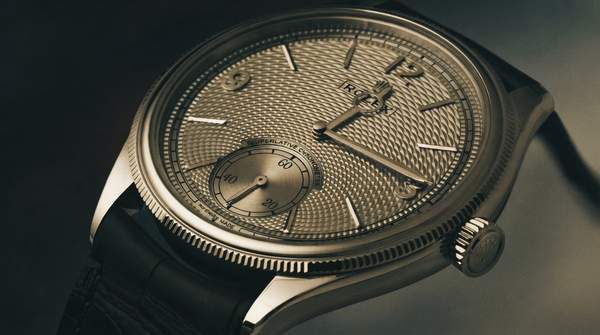
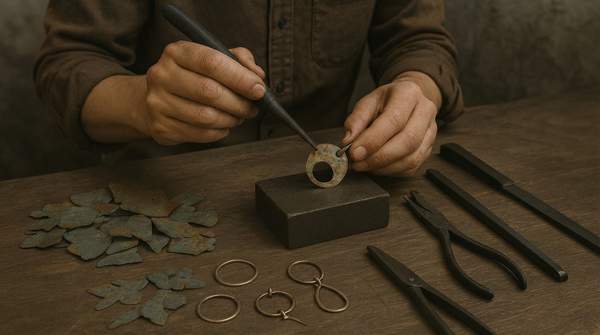
Decoration is where a bespoke movement earns its price. Armin Strom hand-finishes every single surface, including the ones no one usually sees, and the company states that decorating a part to its standards can take up to ten times longer than producing it — which is why more of its watchmakers work on decoration than on assembly. The signature technique is bevelling, or anglage: filing the edges of parts to sharp, clean angles and then polishing these sloping edges to a high shine. For the final stage of bevelling, the manufacture's Decoration Team hand-selects gentian wood in the Swiss mountains every August, a traditional material that allows artisans to achieve flawless, mirror-polished surfaces.
Watch writer Mark Bernardo explains that anglage was once a utilitarian element that now adds aesthetic appeal, much like blued screws, which most high-end watchmakers still produce through traditional thermal tempering rather than a chemical process. The honest qualification here matters: hand-finishing is primarily an aesthetic achievement and a demonstration of skill rather than a guaranteed functional improvement over machine finishing in every case. Its value lies in what it signals — the hours of trained labor embedded in a part — and in the visible quality that distinguishes a luxury movement from a commodity one.
Meticulous Assembly: The Double Assembly Advantage
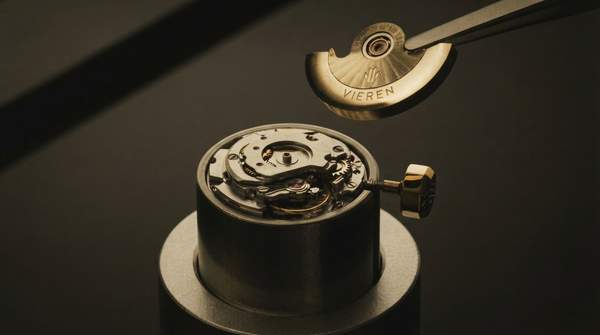
The most counterintuitive hallmark of high-end assembly is doing it twice. After a galvanisation treatment, Armin Strom's decorated components go to a watchmaker who assembles the movement, sets it up, and then takes it apart again. The second assembly happens in a controlled, dust-free environment, where every part is oiled exactly where it needs to be. The manufacture's reasoning is blunt: a single speck of dust could affect timekeeping, so nothing is left to chance. The first assembly functions as a proving run — components are tested, adjusted and verified to work together — before the movement is cleaned and rebuilt under stricter conditions for the definitive build. Each finished movement is then tested for accuracy, amplitude and power reserve over approximately one to two weeks.
Stages of Bespoke Swiss Watch Movement Creation
The framework below deconstructs the process into its distinct stages, pairing each technique with its purpose so the industrial and artisanal phases remain clearly separated.
| Stage | Technique / Process | Purpose / Significance | Precision / Quality |
|---|---|---|---|
| Component production | High-precision CNC machining of 97% of components in-house, followed by hand fine-tuning, measuring and adjustment | Establishes the dimensional foundation every later stage depends on | Tolerances of around 0.005 mm |
| Decoration | Hand-finishing of every surface, including unseen ones; bevelling (anglage) polished with gentian wood selected each August | Adds aesthetic appeal and demonstrates craftsmanship; can take up to ten times longer than producing the part | Flawless, mirror-polished surfaces; primarily aesthetic value, not a guaranteed functional gain |
| Assembly | Double assembly: build, test and adjust, then disassemble, clean and rebuild in a dust-free environment with precise oiling | Proves the components work together and eliminates dust that could affect timekeeping | Followed by one to two weeks of testing for accuracy, amplitude and power reserve |
| Mass-produced comparison (e.g., ETA 2824-2) | Regulated ébauche-based movements supplied across many brands | Illustrates a different manufacturing philosophy: shared architecture rather than bespoke integration | Chronometer-grade versions are specified as accuracy over time (commonly cited around −4 to +6 seconds per day), not as component tolerances |
Read across the rows, the framework shows the division of labor that defines the genre: machines establish precision, hands add value, and the double assembly converts both into verified reliability. The final row also carries a necessary caution — the widely quoted figures for mass-produced movements describe accuracy in seconds per day after regulation, not the dimensional tolerance of their components, so the two numbers measure different things and cannot be compared as like for like.
Precision in Context: Bespoke vs. Mass-Produced Tolerances
The comparison between a bespoke manufacture and a movement supplier such as ETA or Sellita is really a comparison of philosophies. Armin Strom's 0.005-millimetre figure is a manufacturing tolerance — how closely a cut part matches its intended dimension. The specifications attached to mass-produced movements, by contrast, are typically expressed as accuracy over time: chronometer-grade ETA 2824-2 movements are commonly cited within a range of roughly −4 to +6 seconds per day. Those are performance figures for a regulated movement, not component dimensions, and conflating them would misstate the difference. What the contrast does show is where each approach invests: the mass-produced movement optimizes for consistent, certified accuracy at scale, while the bespoke manufacture optimizes for dimensional control, proprietary architecture and hand-finishing that no shared platform carries.
Evaluating the Craft: What to Look for in a Bespoke Movement
When assessing the quality and value of a bespoke Swiss watch movement, prioritize evidence of both extreme manufacturing precision and extensive hand-finishing, particularly techniques like bevelling and double assembly. The case study here gives concrete markers: in-house component production with stated tolerances, hand-finishing applied even to surfaces no one sees, named traditional materials such as gentian wood, and an assembly method that builds the movement twice before weeks of testing. The measurable indicator to look for is the presence of detailed documentation or visual evidence from the manufacturer showcasing specific hand-finishing techniques and the double assembly process — a manufacture that genuinely performs this work can show it, and one that cannot show it probably does not do it.
Sources
- Mechanical watch - Wikipedia — EN
- How a Mechanical Watch Is Made: 5 Steps — Armin Strom - Swiss Watch Manufacture
- Watch Movements: A Comprehensive Guide and FAQ - Teddy Baldassarre
- Automatic Watch Movement vs ETA: 2026 Guide — Haim Watch Company