3D weaving reduces textile waste by weaving yarn directly into three-dimensional, garment-shaped components, bypassing the pattern-cutting stage where conventional apparel manufacturing loses roughly 10 to 20 percent of its fabric as offcuts. For production managers weighing the technology, the decisive question is not whether the waste disappears—it is whether quality, availability, and cost make the process viable for their specific products.
The Challenge of Textile Waste in Fashion Manufacturing
Most clothing today is still made the way it was at the dawn of the Industrial Revolution: patterns are cut from rolls of flat woven fabric, and the pieces are sewn together. As the developer unspun describes it, brands have spent decades lowering costs by trimming technical inefficiencies and labor from that conventional process, but the process itself has remained unchanged. The result is a structural problem: irregularly shaped pattern pieces can never tile a bolt of fabric perfectly, so a share of every roll is destined for the cutting-room floor before a garment exists. I believe that framing matters for sustainability executives, because this waste is not an operational sloppiness that can be managed away—it is baked into the method itself.
Traditional Cut-and-Sew: A Wasteful Legacy
The numbers are well documented. A textile engineering review reports that fabric wastage varies from 10 to 20 percent for adult outerwear, and around 10 percent for trousers, with higher percentages observed for blouses, jackets, and underwear. The cause is geometric: the irregular shapes of pattern pieces make 100 percent fabric utilization unfeasible with traditional pattern cutting. Every garment therefore begins with a built-in material loss, and that loss compounds across production runs, seasons, and product lines. The waste also arrives early in the process—fabric is purchased, dyed, and finished before being partially discarded, meaning the offcuts carry the full upstream cost of the material.
How 3D Weaving Transforms Garment Production
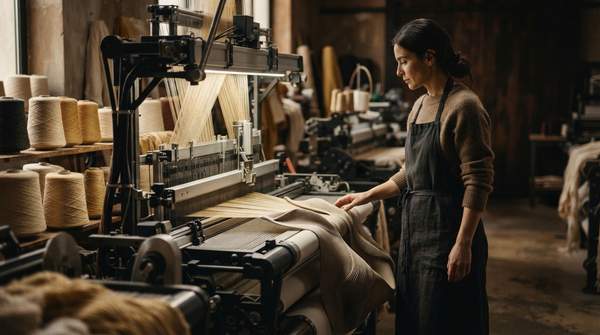
3D weaving takes a different route from the very first input. Instead of producing flat fabric that must later be cut and sewn, a 3D loom weaves yarns into three-dimensional, circular shapes that can form different sizes and configurations. The industry consultant OJ Teq Holdings, which coordinates sourcing and product development for apparel brands, defines it as a manufacturing approach that creates three-dimensional textile structures rather than only flat fabric, with specialized automated equipment able to weave yarn directly into garment-shaped components in certain applications. unspun says its process constructs the bulk of a garment as a single, seamless piece, which the company says minimizes waste while enabling customization and fit accuracy. The company's Vega™ machine also combines sewing and the addition of trims into one step, collapsing stages that cut-and-sew keeps separate.
Comparative Manufacturing Process: Traditional Cut-and-Sew vs. 3D Weaving
The table below juxtaposes the two process flows stage by stage to isolate exactly where material waste occurs—and where the 3D route eliminates it. The critical divergence is at pattern cutting: the traditional method's primary waste point simply does not exist in a yarn-to-garment workflow.
| Process Stage | Traditional Cut-and-Sew | 3D Weaving | Waste Impact |
|---|---|---|---|
| Material input | Rolls of flat woven fabric | Yarn, fed directly to the loom | Fundamental difference in input drives the rest of the process |
| Garment shaping | Patterns cut from flat fabric, producing offcuts | Loom weaves yarn into 3D, garment-shaped components or single seamless pieces | Primary waste stage: 10–20% fabric loss for adult outerwear, ~10% for trousers; bypassed entirely in 3D weaving |
| Assembly | Extensive sewing to join cut pieces | Sewing minimized or combined; Vega™ merges sewing and trim attachment into one step | Fewer process steps; less material handling |
| Output | Finished garment plus leftover fabric scraps | Finished garment-shaped component with minimal leftover material | Offcut waste largely eliminated at the source |
Read the second row closely, because it carries the whole argument. In cut-and-sew, waste is created the moment pattern pieces are cut from flat fabric; in 3D weaving, the garment's shape is established during weaving itself, so there is no flat fabric to cut and no offcuts to discard. The waste is not recycled or reduced—it is prevented from existing.
Key Considerations for Adopting 3D Weaving Technology
The waste case is strong, but OJ Teq Holdings advises brands to weigh the technology against proven product quality, commercial availability, and realistic manufacturing costs. Three factors deserve attention. First, quality still depends on specification: brands must define garment measurements, intended fit, material characteristics, finishing requirements, and acceptable quality standards, and a digitally manufactured garment can still have problems if the approved specifications are incorrect. Second, availability and scalability: unspun's first micro-factory debuted in Oakland, California, with the stated longer-term goal of supply chain adoption at scale to bring costs down, and the approach is positioned to enable just-in-time, make-what-you-sell production.
Third, cost: unspun argues that 3D weaving decreases production expenses by saving more and wasting less, but the consultant cautions that a shorter manufacturing process does not necessarily guarantee a lower finished-garment price. A full cost-benefit analysis is beyond this article's scope, but the tension between developer claims and consultant caution is exactly where a production manager's evaluation should begin.
One further caveat belongs in any honest assessment. Reporting by Rachel Cernansky in Vogue notes that while three-dimensional weaving has the potential to eliminate the fabric scraps generated during cut-and-sew, that problem is much smaller by volume than overproduction. Cutting-stage waste is real and measurable, but it is one waste stream among several in the apparel lifecycle—this article addresses only the offcut problem.
Evaluating 3D Weaving for Your Sustainability Goals
Fashion production managers and sustainability executives should assess 3D weaving technology as a viable strategy for significant textile waste reduction by focusing on its ability to eliminate fabric offcuts. The mechanism is now precise: by weaving yarn directly into garment-shaped, three-dimensional components, the technology removes the pattern-cutting stage responsible for the 10 to 20 percent fabric loss documented in conventional manufacturing. The measurable indicator to watch is a pilot project demonstrating reduced material waste percentages in garment production compared to traditional methods, along with an evaluation of product quality and scalability for specific garment types. That pilot—run against your own baseline offcut rates for a defined product category—is the concrete next step the evidence supports.