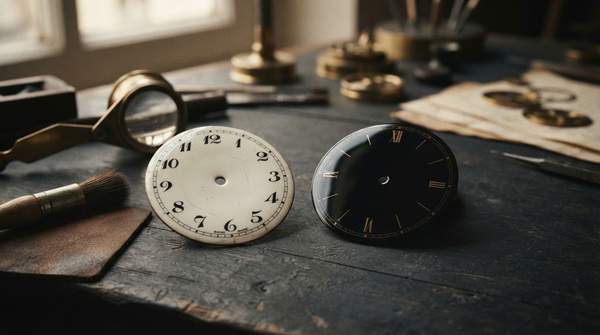
The fastest way to tell a hand-painted enamel dial from a traditional lacquer dial is to look at how the surface behaves under light: enamel, a fused layer of powdered glass fired at temperatures above 1,500 degrees Fahrenheit, presents a hard, glassy depth, while lacquer, built from many thin layers of natural tree sap, carries a deep, soft luster that can range from opaque to translucent. These two great families of artisanal dial work—European miniature painting on enamel and Asian lacquer traditions such as Japanese Urushi and Vietnamese Sơn Mài—produce unmistakably different surfaces because their processes are fundamentally opposed: one is shaped by fire, the other by patient layering and curing. Understanding those processes is what allows a collector to move from admiring a dial to identifying it.
The Art of the Dial: A Collector's Guide to Hand-Painted Craftsmanship
In the current era of métiers d'art, watches with hand-painted dials have become, as horological coverage puts it, wearable works of art, where the convergence of watchmaking and fine art represents a pinnacle of creativity. Amid digital saturation and what one publication calls "AI perfection, and constant screen fatigue," these dials carry a significant imprint of human craftsmanship that machine production cannot replicate.
A hand-finished dial is created entirely or predominantly by artisanal methods rather than mass production, with each dial becoming a one-of-a-kind object whose variations in depth, light reflection, and character no industrial process can reproduce. Collectors place great weight on the dial when evaluating a watch because decorative textures create subtle reflections that change with light, and because traditional techniques demand time and skill that increase the piece's value. This guide concentrates on the two great artistic painting traditions—enamel and lacquer—rather than mechanical finishes such as guilloché engine-turning or gem-setting, and it is intended for identification and appreciation, not as a tutorial for making dials.
Miniature Painting on Enamel: The Fiery Art of Grand Feu
Enamel is not a paint or fluid at all. It is a powdered glass mix—composed, according to Ulysse Nardin's account of its Donzé Cadrans workshop, of silica, minium, potash and soda—obtained by fusion at high temperature. The dial maker first prepares a dial base, then "dusts" it with these glass particles until they form a fine layer. To achieve enamel's distinct glassy finish, the dial is fired in a kiln at temperatures over 1,500 degrees Fahrenheit; this "grand feu"—great fire—fuses the powder into the base and creates a smooth surface.
Miniature painting on enamel goes further. As Worn & Wound's guide to métiers d'art dials describes, artisans use exceedingly fine brushes to apply paint directly onto the enamel base before firing the layers to melt the two together. Every stroke must be perfect at the risk of ruining the entire dial, and every layer must be independently fired and fused. Shading is achieved by layering opaque or translucent enamels, and materials like gold or silver can be layered in for additional brilliance.
The repetition is where the danger lies. Girard-Perregaux explains that the dial is painted with a layer of enamel, fired in the kiln, removed, cooled, and then the process repeated, typically five to ten times, to ensure a homogenous surface with deep, intense colors. Each additional firing heightens the risk of bubbles, cracks or other imperfections appearing—culminating in the dial being discarded. A beginner's guide from O&HoraPictor reports that complex patterns typically demand eight or more firings, with careful observation at each stage, and that mastery often takes artisans ten to twenty years, since each batch of enamel behaves slightly differently. The firing process is not uniform: determining completion requires extensive artisan experience and an intuitive understanding of materials and heat.